Defensive security / Case study
Cyber Dragon
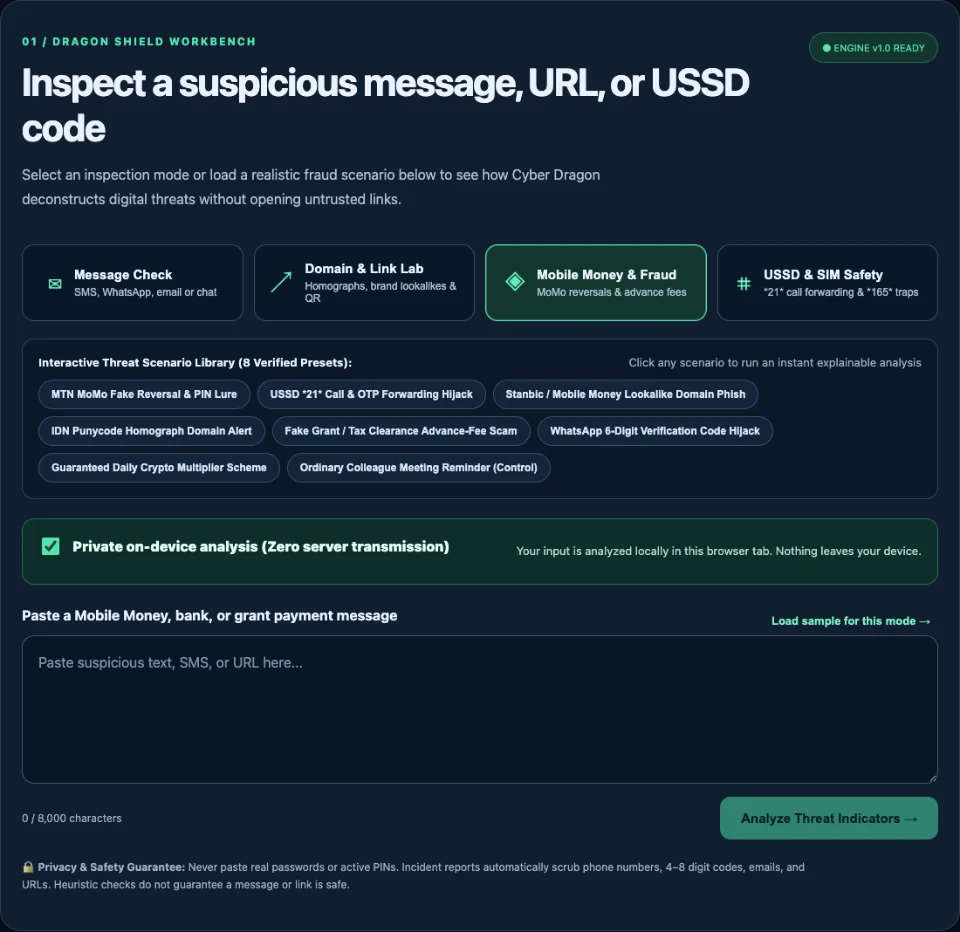
Inspect suspicious messages without opening the link.
A browser workbench that explains the signs of mobile-money scams, lookalike domains, and USSD traps.
- Type
- Open-source engineering
- Release
- v1.0.0
- Stack
- TypeScript · Python · Next.js 15 · FastAPI
- Automated tests
- 25
01 / Problem
Why it exists
Phishing and digital fraud in mobile-first markets frequently combine spoofed SMS deposit alerts, USSD call/OTP forwarding traps (*21*, *165*), and combo-squatted lookalike domains. Traditional URL scanners fetch submitted links from backend servers—exposing scanners to Server-Side Request Forgery (SSRF) and alerting attackers via tracking beacons.
02 / Design
How it works
Perform 100% static lexical and structural URI inspection using standard parsers, brand allowlists, edit-distance checks, and Punycode inspection without network I/O.
5-Dimension Lexical & Structural Threat Analyzer
Evaluates messages and URLs across credential harvesting, Mobile Money/USSD abuse, domain deception, coercive urgency, and advance-fee fraud in both TypeScript and Python.
Levenshtein & Homoglyph Brand-Impersonation Detector
Compares hostnames against 18+ protected brands (MTN, Airtel, M-Pesa, Stanbic, Centenary, Equity, Flutterwave, Paystack, Chipper, URA, NSSF, WhatsApp, Telegram, Google, Microsoft, Apple, PayPal, Binance).
PII Scrubber & Incident Report Exporter
Masks phone numbers, 4–8 digit numeric codes, emails, USSD strings, and secret tokens before generating Markdown or JSON incident briefs.
SSRF-Free Static Heuristic Architecture Over Live URL Fetching
- Context
- Fetching user-submitted URLs from a backend server exposes internal infrastructure to SSRF and triggers attacker tracking beacons on personalized phishing links.
- Decision
- Perform 100% static lexical and structural URI inspection using standard parsers, brand allowlists, edit-distance checks, and Punycode inspection without network I/O.
- Trade-offs
- Cannot inspect destination DOM content behind shortened URLs (bit.ly), which are therefore flagged as obfuscated links requiring independent verification.
- Verification
- Verified across 12 Node.js unit tests, 8 benchmark scenarios, and 13 FastAPI endpoint tests.
Security and operational constraints
- Zero external network fetches: untrusted URLs are never visited or resolved.
- On-device browser analysis mode enabled by default so sensitive text never leaves the user tab unless explicitly submitted.
- Non-echoing ScanResult contract verified by unit tests so raw credentials never appear in API responses.
- Zero outbound HTTP/DNS requests are ever performed on user-submitted URLs (eliminating SSRF by construction).
- ScanResult payloads never echo raw user secrets or URL query tokens.
- Low indicator scores are always accompanied by an explicit advisory disclaimer rather than a false safety guarantee.
03 / Evidence
How to verify it
Repository-reported / Heuristic Latency & Accuracy
0.28 ms · 8/8 Corpus100% expected risk-level match across 8 curated fraud & benign control scenarios with zero external network calls
Reproduce from the command line
git clone https://github.com/codesphere-u/cyber-dragon.git
cd cyber-dragon/apps/web && npm install && npm test && npm run benchmark
node --experimental-strip-types bin/cyber-dragon.mjs scan "URGENT: Dial *21*0772112233# now"